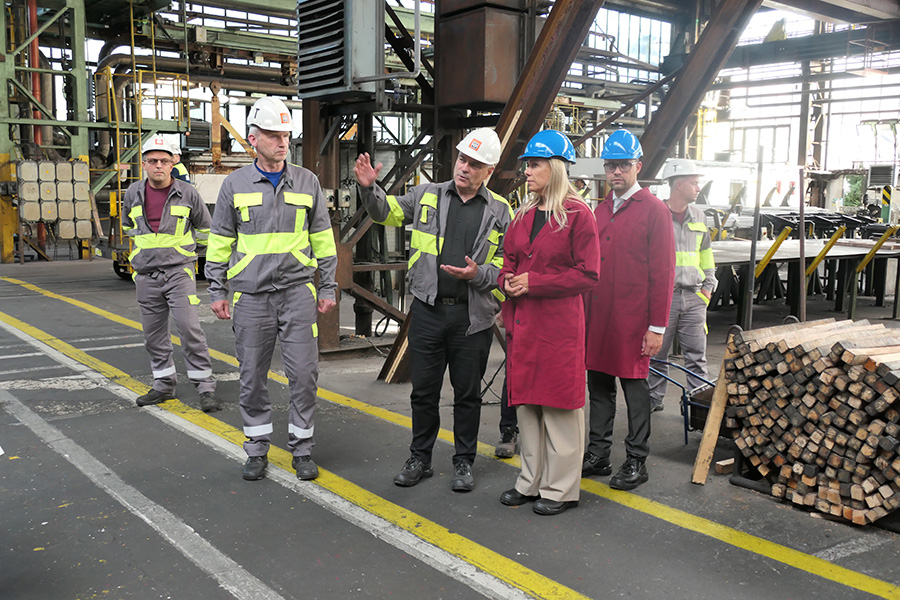
Visit of the Minister of Economy to Železiarne Podbrezová
Železiarne Podbrezová was visited by Deputy Prime Minister of the Slovak Republic and Minister of Economy Denisa Saková, accompanied by State Secretary Szabolcs Hodosy. During the visit, they met with the company’s management, led by Chairman of the Board and CEO Vladimír Soták, and toured all three main production plants.
The main topics of the meeting were the current situation in industry, the competitiveness of European manufacturers and, above all, high energy prices, which represent one of the biggest challenges for energy-intensive companies.
Modernisation, automation and high production quality
During the visit, representatives of the Ministry of Economy of the Slovak Republic familiarised themselves in detail with the production processes, technologies used and the company’s further development plans. The Minister particularly appreciated the company’s ability to continuously modernise and respond to changing market conditions.
“Hats off to the companies that were established here in the past, because they have endured, revitalised themselves and continue to operate. I have to admit that I am impressed by what I have seen. It is not only about what was inherited from the past, but also about the overall progress of Železiarne Podbrezová, whether in decarbonisation projects and environmental protection, or in increasing labour productivity. New automation solutions are being introduced and the quality of their products is at a very high level,” said Denisa Saková.
The Minister also highlighted the innovations and technological solutions that the company is implementing based on many years of experience and international know-how.
“The management of Železiarne Podbrezová is constantly looking for new technological processes to make production as cost-effective and efficient as possible, because today’s market is very demanding and customers put strong pressure on prices. If this company wants to remain competitive in the future, it must focus on its pricing policy and ensure that its products remain affordable for customers.”

High energy prices remain a serious problem
A significant part of the discussions focused on electricity prices and other input costs. According to the Minister, this is not only a problem for Slovak industry, but for Europe as a whole.
“Prices are several times higher, for example, compared with China or the United States. If we do not want our industrial plants and the pride of our manufacturing sector to shut down their operations, it is important to look at input costs. The state must support energy-intensive companies and help adjust prices. However, this cannot mean reducing them to a minimum, because within the single European market we are bound by certain rules and procedures,” she said.
The Minister also pointed to the specific features of the European energy market. Slovakia is part of an interconnected European system in which generated electricity is traded on the common market. According to her, Central European countries face higher energy prices than several other regions of Europe despite having sufficient generation capacity and well-developed transmission infrastructure.
Support for industry must respect EU rules
Another topic discussed was the possibility of state support for energy-intensive companies. According to the Minister, every support scheme must comply with European Union rules and must be designed in a way that does not create disproportionate competitive advantages between individual Member States.
“If the state wants to support industry, it must do so within limits that do not violate EU rules. It is often complicated, but if the state still has options to help while respecting the rules, it should do so. And that is exactly what we discussed with the management of Železiarne Podbrezová,” said Denisa Saková.
The Minister also emphasised the importance of Železiarne Podbrezová for both the region and the Slovak economy.
“From the position of the Government of the Slovak Republic and the Ministry of Economy, we will seek to accommodate and support companies such as Železiarne Podbrezová. They employ approximately 2,600 people, are the largest employer in the Horehronie region and play an important role in the Slovak economy. We therefore cannot afford a situation in which they would one day no longer be here or would operate only in a limited mode,” the Minister concluded.
The visit by representatives of the Ministry of Economy of the Slovak Republic provided an opportunity to present the company’s current situation directly at its production plants and to discuss the conditions necessary to maintain the competitiveness of Slovak industry in both the European and global environment.
Author (source): Podbrezovan